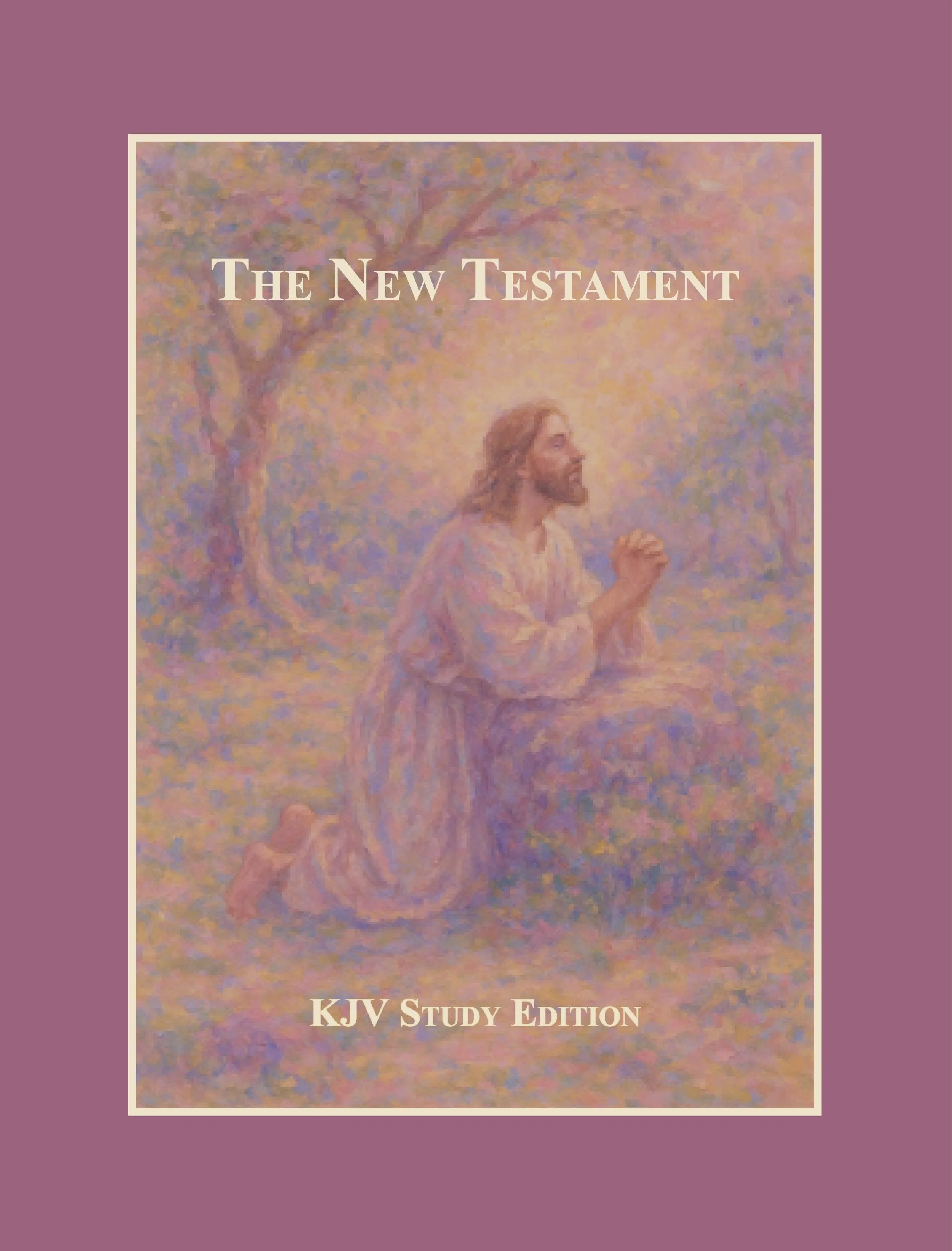
The King James New Testament
Faith Tradition:
Anglican (with broad Christian readership)
Source Edition:
1769 Edition
Available Formats:
Paperback (8.5 × 11)
Description:
The KJV New Testament: Wide-Margin Study Edition
A refined edition of Scripture for thoughtful reflection and lasting study.
Experience the King James Version New Testament in a beautifully designed, wide-margin format made for journaling, study, and deep engagement with God’s Word. Crafted with elegance and purpose, this edition invites you to slow down, reflect, and write as you read—transforming your study time into a personal and meaningful dialogue with Scripture.
Perfect for devotion, sermon preparation, or lifelong learning, this edition combines the historic language of the 1769 KJV with a layout that encourages both insight and inspiration.
Features You’ll Love
Wide 2-inch margins for journaling, cross-references, and study notes
Letter-size pages (8.5” × 11”) for generous writing space and easy readability
Refined, elegant design aesthetic that complements any study setting
Classic Minion Variable 9-point font — crisp, readable, and timeless
Cream paper for comfortable reading and a traditional Bible feel
Black-and-white interior for sharp contrast and enduring clarity
Editor’s Preface offering insight into the KJV’s historical legacy
Perfect For
Bible journaling, devotion, and reflection
Sermon preparation and study outlines
Christian gifts for students, pastors, and lifelong learners
Homeschool or ministry programs centered on Scripture study
Why You’ll Love This Edition
For centuries, the 1769 King James Version has inspired readers with its reverent beauty and faithful translation. This edition preserves that majesty while providing the space to engage deeply—through study, writing, and prayer.
The wide-margin design encourages reflection, helping you record your thoughts, insights, and personal growth alongside the text. It’s a Bible built not only to read—but to live with, grow through, and one day pass on.
Specifications
Format: Paperback with wide study margins
Dimensions: letter size binding 8.5” × 11”
Language: English (1769 King James Version)
Elegant, enduring, and designed for engagement—this study edition invites you to experience the Word with both heart and mind.
Editor’s Preface
Few works have traveled so far, touched so many lives, or shaped so many conversations as The New Testament. For nearly two thousand years, its words have been copied, translated, debated, recited, and carried across continents. It has inspired works of art and literature, guided moral and philosophical debates, and shaped the course of history in profound ways. Whether read as sacred Scripture, as an account of the beginnings of Christianity, or as a landmark in world literature, The New Testament holds a place of enduring importance.
Its twenty-seven books were written in the first century CE by different authors, each with distinct perspectives and purposes. Together, they present narratives, letters, and visions that have been read aloud in churches, studied in classrooms, and pondered in private reflection for generations. For many readers, these pages speak directly to questions of meaning, morality, and human destiny. For others, they offer a window into the culture, language, and ideas of the ancient Mediterranean world.
Over years of returning to this text, I have found that the experience of reading it changes with time. The words on the page remain the same, but the reader’s own vantage point shifts. A passage that once seemed simple may later feel layered with complexity; a story overlooked in one reading may stand out vividly in another. This capacity to yield fresh perspectives is part of what makes the New Testament an enduring companion for study and reflection.
The version presented here follows the 1769 Oxford revision of the King James Version (KJV). The KJV itself was first published in 1611, the product of more than fifty scholars commissioned by King James I of England. Working in six committees across Oxford, Cambridge, and Westminster, they drew on the best Hebrew and Greek manuscripts available to them, as well as earlier English translations. Their goal was to produce a Bible suitable for public reading in worship, marked by clarity, dignity, and beauty of expression.
The 1611 edition reflected the spelling, punctuation, and typographical practices of its time, many of which feel unfamiliar to modern readers. Over the next century and a half, the English language moved toward more standardized forms. In 1769, Benjamin Blayney of Oxford University undertook a careful revision to align the KJV text with contemporary spelling and grammar, correct typographical inconsistencies, and regularize the use of italics for words supplied in translation. His work did not alter the meaning or overall style of the original translation; it refined its presentation for an eighteenth-century audience. This 1769 Blayney text became the standard KJV in use today, and it is the form reproduced in this edition.
The New Testament begins with the four Gospels—Matthew, Mark, Luke, and John—which present overlapping but distinct accounts of the life, teachings, death, and resurrection of Jesus of Nazareth. Matthew draws heavily on Hebrew Scriptures; Mark’s account is concise and fast-paced; Luke offers a detailed and orderly narrative; John’s Gospel is more reflective and theological in style.
The Acts of the Apostles follows, bridging the story of Jesus with the early growth of the Christian movement. It recounts the spread of the message from Jerusalem outward, with a focus on the work of Peter and Paul.
Next come the Pauline Epistles, letters attributed to Paul the Apostle. Addressed to early Christian communities and individuals, they combine theological reasoning with practical instruction. These are followed by the General Epistles—letters written by James, Peter, John, and Jude—which provide guidance, encouragement, and warnings to a broader audience.
The New Testament concludes with the Revelation to John, a work rich in symbolism and imagery. Its visions have been interpreted in many ways across the centuries, and its themes of perseverance, justice, and renewal continue to resonate.
The path to forming the New Testament canon was gradual. In the early centuries, Christian communities circulated various writings, some of which gained widespread use while others remained local or contested. By the fourth century, the twenty-seven books we now know as the New Testament had been widely recognized by church leaders as authoritative.
The King James translation brought these writings into an English form that has endured for more than four centuries. Its phrasing has become part of the English-speaking world’s literary and cultural heritage, with expressions like “labour of love” and “the powers that be” entering common use far beyond the Bible’s readership. This influence reflects both the skill of its translators and the enduring appeal of the material they rendered.
The edition you hold is designed to present the 1769 KJV New Testament in a way that encourages attentive reading. The layout is clear and consistent, supporting both continuous reading and focused study. The language is unchanged from the Blayney revision, preserving the cadence and vocabulary that have made the King James Version so distinctive.
The New Testament’s appeal is not confined to any single audience. People approach it from many angles—faith, history, literature, philosophy—and find material that speaks to their interests. Its influence extends into law, ethics, education, and the arts. It has been invoked to justify action and to call for reform, to comfort the grieving and to inspire the hopeful.
For those new to the KJV, the style may require a short adjustment, but its rhythm and balance soon become part of the reading experience. For those familiar with it, the text can still surprise. Passages encountered many times before may suddenly stand out in a new light. Links between books or themes may emerge unexpectedly.
This edition does not interpret the text for the reader, nor does it present a particular theological position. It seeks to provide a faithful reproduction of the 1769 KJV New Testament, leaving each reader free to approach it according to their own perspective.
Whatever your reason for opening this book—personal study, academic research, literary appreciation—you are entering into a collection of writings that has influenced centuries of thought and culture. It is a work that has been read in times of peace and in times of conflict, in private devotion and in public ceremony, in countless languages and in settings as varied as the people who have turned its pages.
May this edition serve as a reliable and clear presentation of a text that has been part of the human conversation for generations. In preserving the language and structure of the 1769 King James Version, it offers a link to the long tradition of English Bible reading, while inviting engagement with a work that continues to speak—through history, literature, and culture—to each new generation of readers.
—Ken Simes