The Meditations of Marcus Aurelius
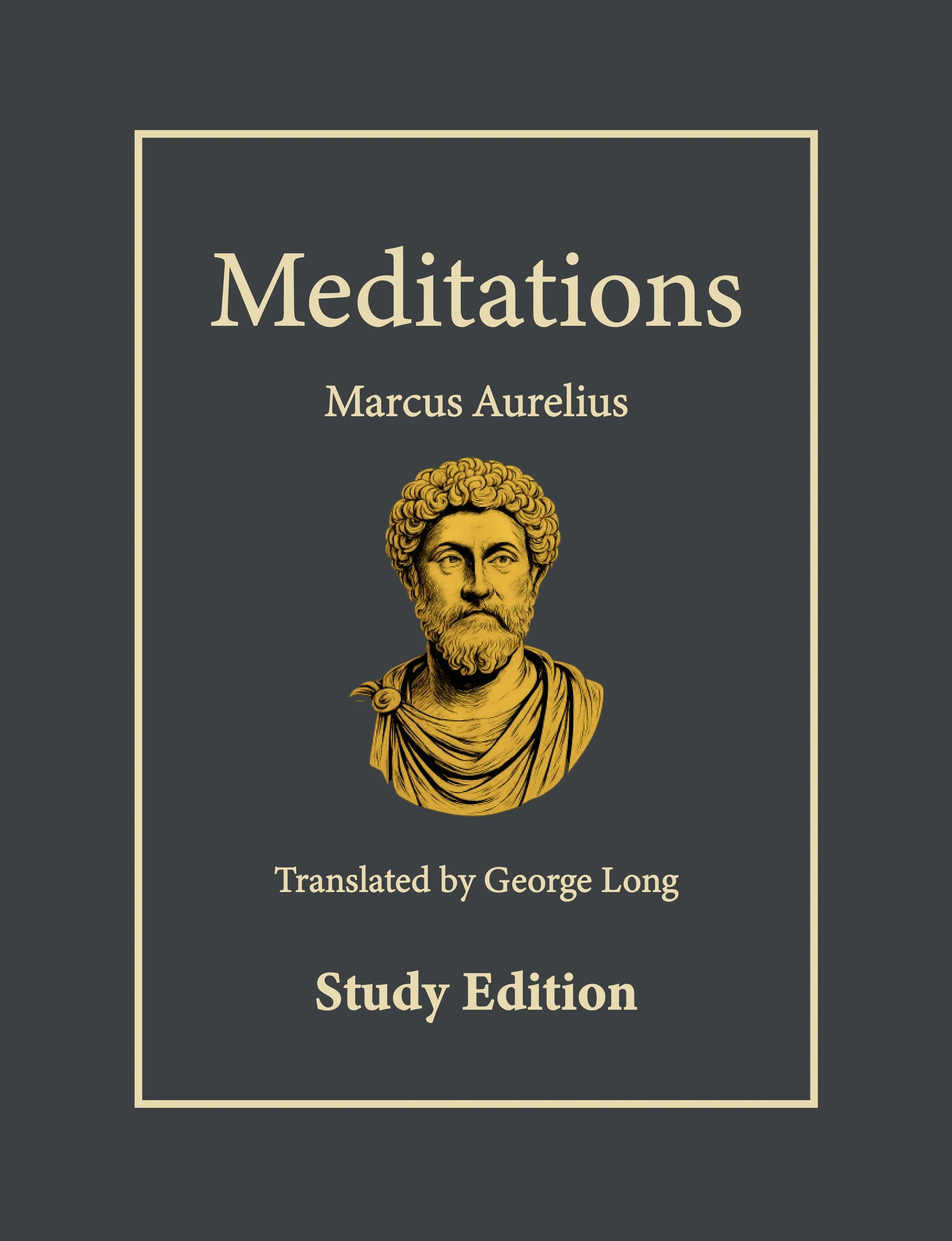
Author:
Marcus Aurelius
Source Edition:
1862 George Long Translation
Available Formats:
Paperback (8.5 × 11)
Description:
A timeless classic of Stoic philosophy — now in a wide-margin study edition designed for reflection, note-taking, and personal growth.
Marcus Aurelius, Roman emperor and philosopher, never intended his Meditations to be published. These private writings were reminders to himself of how to live with integrity, patience, and humility in the face of hardship. Nearly two thousand years later, his words remain a guide for readers seeking clarity, resilience, and wisdom.
This edition is based on the enduring George Long translation (1862), one of the most widely available public-domain renderings of Marcus’s text. Reformatted with extra-wide outside margins and a reflections section at the back, it is built not just for reading but for engagement.
Features of this Study Edition
Wide outside margins for notes, questions, and personal responses
Reflections section at the end for longer journaling and study notes
Clear 12-point typeface for comfortable reading
Preface by the editor introducing Marcus Aurelius and the purpose of this study edition
Durable letter-size format (8.5 × 11) ideal for extended annotation
Whether you are a student of philosophy, a teacher, or an individual seeking a tool for reflection, this edition offers both the timeless wisdom of Marcus Aurelius and the space to make it your own.
Perfect for students, teachers, reading groups, and anyone who wants to not only read Meditations but live with it.
Editor’s Preface
Few books have endured with such quiet power as Meditations, by Marcus Aurelius. Written nearly two thousand years ago, not for public release but as private reflections, it remains one of the most honest and intimate works of philosophy ever preserved. Marcus Aurelius, Roman Emperor from 161 to 180 CE, kept these notes as reminders to himself of the values he wished to embody. They were not intended for anyone else’s eyes. Yet in their survival, we are given a rare glimpse into the mind of a ruler struggling with the same challenges of distraction, self-doubt, frustration, and loss that face us all.
The text of Meditations has been transmitted through the centuries in fragments, translations, and commentaries. The version presented in this study edition is the classic translation by George Long, first published in 1862. Long’s rendering has remained one of the most widely available public domain translations, giving English-speaking readers access to Marcus’s thoughts in clear, if somewhat formal, Victorian prose. While later translations have offered updated language, Long’s remains a touchstone for generations of readers, and its cadence and phrasing still carry the weight of serious reflection.
The purpose of this edition is not merely to reproduce Long’s translation, but to present Meditations in a format designed to encourage slow reading, note-taking, and personal engagement. The pages are laid out with wide outside margins, giving space for the reader’s own observations, questions, or responses. At the end of the volume, additional pages are reserved for more extended reflections. The goal is to restore Meditations to something like its original function: not a polished treatise, but a working notebook of self-examination.
In this way, this edition seeks to revive the practice of philosophy as Marcus Aurelius himself understood it—not as abstract speculation, but as a daily discipline. Stoicism, the philosophical tradition that shaped Marcus’s thought, emphasized the cultivation of virtue through constant reflection. The Stoic ideal was not to withdraw from the world but to meet it with equanimity, justice, and reason. For Marcus, this task was made all the more urgent by his position as emperor, where every decision carried immense consequence. Yet he never wrote these words to justify power or celebrate conquest. Instead, he returned again and again to reminders of humility, patience, and the inevitability of mortality.
It is striking to consider that one of the most powerful men in history turned inward not to glorify himself but to examine his failings. “Begin the morning by saying to thyself,” he writes, “I shall meet with the busybody, the ungrateful, the arrogant, the deceitful, the envious, the unsocial.” In these lines, we hear not the voice of a distant ruler but of a fellow traveler, preparing for the frustrations of a normal day. He counsels himself to respond not with anger but with understanding—that others act as they do from ignorance of good and evil, and that it is within our power to remain steadfast in our own integrity.
This enduring relevance is why Meditations continues to attract readers across cultures and centuries. The challenges Marcus faced—political turmoil, military campaigns, personal loss—are different in scale from our own, but not in essence. His words remind us that we cannot control the actions of others, nor the larger events of history, but we can control our own judgments and responses. For this reason, Meditations has been embraced not only by philosophers and historians, but by leaders, soldiers, athletes, and countless ordinary readers seeking guidance in the face of hardship.
This study edition is designed with such engagement in mind. The wide margins invite the reader to converse with Marcus across the centuries, recording agreements, disagreements, or practical applications. In the back, the reflections section provides a space for longer responses—perhaps to track how one’s understanding evolves over time, or to note connections with personal experience. By treating Meditations as a living dialogue rather than a static text, readers may find that Marcus’s voice becomes less a distant echo of the past and more a companion in the present.
As editor, I offer no commentary beyond this preface. The purpose is not to interpret Marcus for you, but to clear the ground so that you may engage directly with his words. Each reader will find different passages that speak most strongly—some may draw strength from his reminders of mortality, others from his insistence on duty, others still from his refusal to yield to bitterness. The value lies not in arriving at a single “correct” interpretation, but in discovering how his reflections illuminate your own path.
In the end, Marcus Aurelius never expected us to read these notes. Their survival is an accident of history. Yet perhaps this is part of their enduring power: they are not written to persuade or impress, but to remind and instruct. They are a record of a man striving to be better, despite every reason to despair. If he, in the midst of war, plague, and imperial responsibility, could return daily to the practice of reflection, so might we.
This edition invites you to do just that. Take up Marcus’s words slowly. Mark the margins with your thoughts. Return often. In the conversation between his struggles and yours, you may find not only wisdom but encouragement to continue the lifelong work of becoming who you wish to be.
—Ken Simes