The Pilgrim’s Progress
Part One
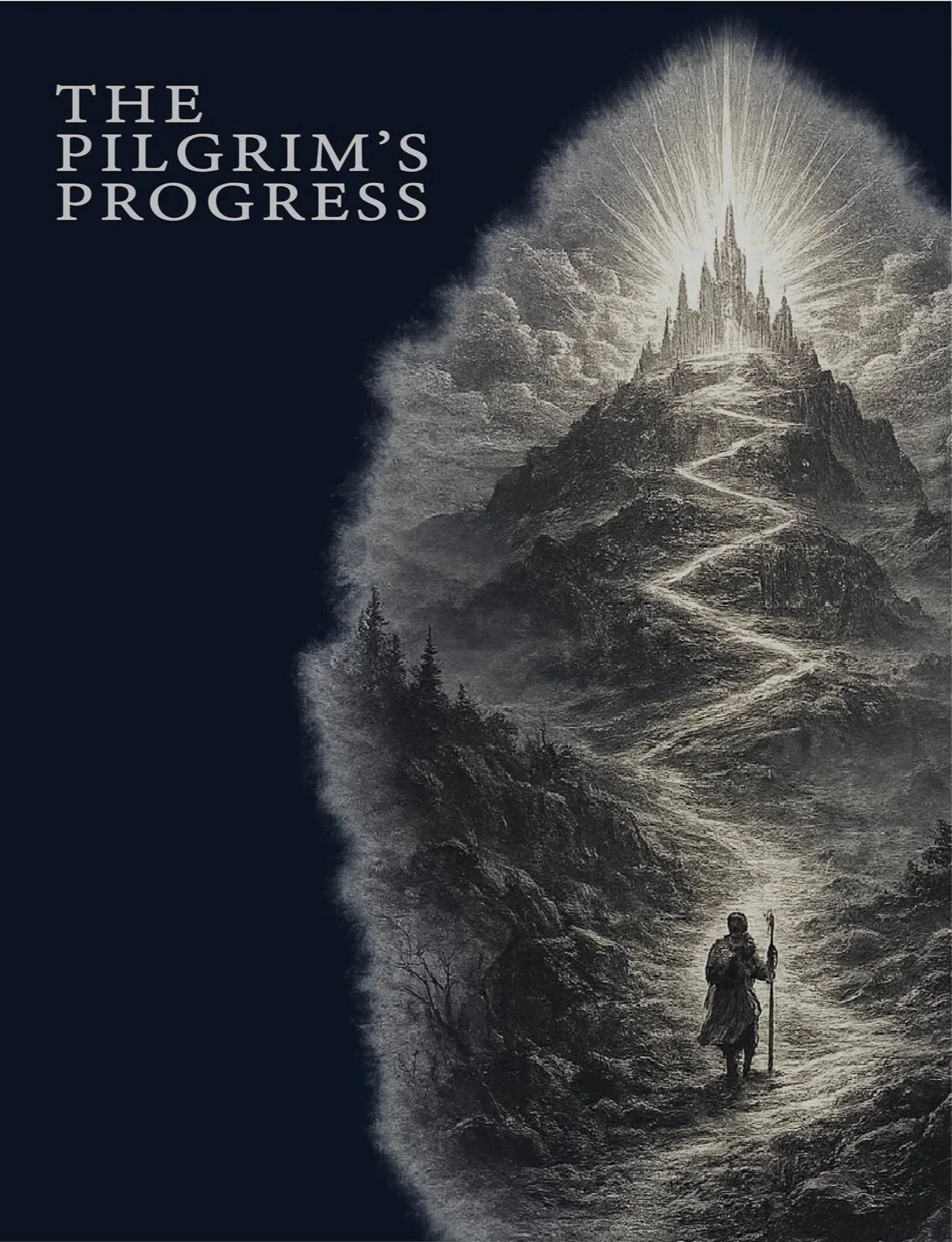
Author:
John Bunyan
Faith Tradition:
Protestant Christianity
Source Edition:
1678 Edition
Available Formats:
Paperback (8.5 × 11)
Description:
The Pilgrim’s Progress (Part One): Wide-Margin Study Edition for Reflection and Annotation
A timeless allegory—presented in a format designed for thoughtful reading, personal insight, and spiritual growth.
First published in 1678, The Pilgrim’s Progress, by John Bunyan has remained one of the most influential works in Christian literature. Its story of Christian’s journey from the City of Destruction to the Celestial City has inspired readers across centuries, cultures, and denominations. This edition preserves the complete public-domain text of Part One, carefully formatted for clarity and accessible reading in a modern study layout.
Designed for Study, Meditation, and Personal Growth
This wide-margin edition includes:
Extra-wide outer margins for notes, reflections, prayers, or study insights
Clean, spacious typesetting that enhances readability
A dedicated reflections section for capturing personal applications
A traditional, timeless interior aesthetic in keeping with the spirit of Bunyan’s original vision
Whether used devotionally, academically, or in small-group study, this edition provides space to engage deeply with the text.
Unabridged, Unmodernized, and Faithful to the Original
This edition contains:
The full public-domain 1678 Part One text
Bunyan’s Author’s Apology
Bunyan’s Conclusion
No added chapter divisions—the narrative appears as Bunyan originally wrote it
The story unfolds as a continuous allegorical journey, preserving the structure that has shaped Christian imagination for over three centuries.
A Journey That Still Speaks Today
Through vivid encounters at the Slough of Despond, the House of the Interpreter, the Valley of Humiliation, Vanity Fair, and beyond, Bunyan portrays the challenges and hopes of the Christian life with poetic simplicity and spiritual force.
Readers will find enduring lessons on:
Perseverance in trials
Discernment in temptation
The companionship of faithful friends
The hope of redemption and transformation
Perfect For
Personal devotional reading
Bible study groups
Homeschool and classical education
Church libraries
Christian gift-giving
Anyone seeking a beautiful, study-friendly edition of a classic
A Meaningful, Interactive Edition
Rather than a small, condensed paperback, this edition offers generous room to write, think, and respond. The wide-margin layout invites the reader to turn this book into a personal record of spiritual growth.
About This Edition
This is an independent publication. The underlying text is fully in the public domain. All layout design, formatting, typesetting, and editorial materials are original to this edition and created for the benefit of modern readers.
Editor’s Preface
Few works in Christian literature have traveled as far or endured as long as The Pilgrim’s Progress. First published in 1678 from a prison cell in Bedford, John Bunyan’s allegory has moved across continents, languages, and centuries with surprising ease. It has been read by scholars and schoolchildren, quoted from pulpits and cottage hearths, and carried by missionaries into lands Bunyan could never have imagined. Its appeal lies not in the ornament of its style but in the clarity of its vision: the journey of a single soul from ruin to redemption.
Bunyan wrote at a time when questions of conscience, faith, and spiritual authority were not abstract matters but urgent realities. As a dissenting preacher in seventeenth-century England, he lived under suspicion and legal restriction. His refusal to cease preaching led to imprisonment, and it was during one of these confinements that he shaped this narrative. Deprived of freedom, he turned inward, exploring through story the trials and consolations of the Christian life. What emerged was neither a theological treatise nor a sermon but a tale, a dream, told with uncommon honesty and conviction.
The story follows Christian, an ordinary man burdened by the weight of his own failure and fear. From the moment he flees the City of Destruction until the hour he enters the Celestial City, he encounters figures who embody the spiritual struggles every person faces: despair, pride, confusion, presumption, and fear. He also meets guides and helpers who strengthen him: Evangelist, Good-Will, the Interpreter, and the faithful companions he finds along the way. Each scene is drawn with the simplicity of a fable yet carries a depth that invites reflection at every turn.
In this study edition, the text is presented in a form that encourages slow, attentive reading. Wide margins allow space for annotation, meditation, and personal response. Bunyan’s images are vivid, but their meaning deepens when considered deliberately. What does the Slough of Despond represent in one’s own experience? What burdens still need to be laid down at the Cross? Which companions on the road bring strength, and which lead astray? By reading with pencil in hand, the reader joins the long tradition of those who have wrestled with the book as both a story and a mirror.
It is worth noting that Bunyan’s allegory reflects the historical and religious assumptions of his time. Some of his images, especially regarding salvation, doctrine, and spiritual danger, arise from the intense sectarian atmosphere of seventeenth-century England. These elements should not be read as prescriptive for all Christians or all eras. Rather, they reveal the earnestness with which Bunyan engaged the spiritual questions of his age. His purpose was not to narrow the faith but to illuminate the inner journey every believer must navigate. The reader is encouraged to approach these passages with discernment, appreciating the symbolic power of the narrative while recognizing its historical frame.
What has allowed this book to endure long after its original controversies faded is the universality of its central theme: the human longing for meaning and the hope of transformation. Beneath the archaic language and vivid personifications lies a simple truth: each life is a pilgrimage. We leave behind what is destructive, press through trials that test our resolve, and seek a destination that promises wholeness. Bunyan’s genius was to express this inner movement in a way that is both imaginative and unmistakably relatable.
This edition preserves the public-domain text of Part One without modernization, offering readers the chance to encounter Bunyan’s language as it has been received for generations. At the same time, the layout and structure are designed to make the reading experience accessible for contemporary study. Reflection pages placed at the end as well as large margin space throughout provide room to pause, consider, and respond. In this way, the book becomes not only a work to read but a companion for personal growth.
May this journey through The Pilgrim’s Progress deepen your understanding of your own path. Whether you approach it as a devotional work, a literary classic, or a guide for reflection, may it invite you to examine the terrain of your heart and the direction of your steps. Above all, may it remind you that courage, perseverance, humility, and hope remain as necessary today as they were when Bunyan first put pen to paper.
—Ken Simes