The Confessions of Saint Augustine
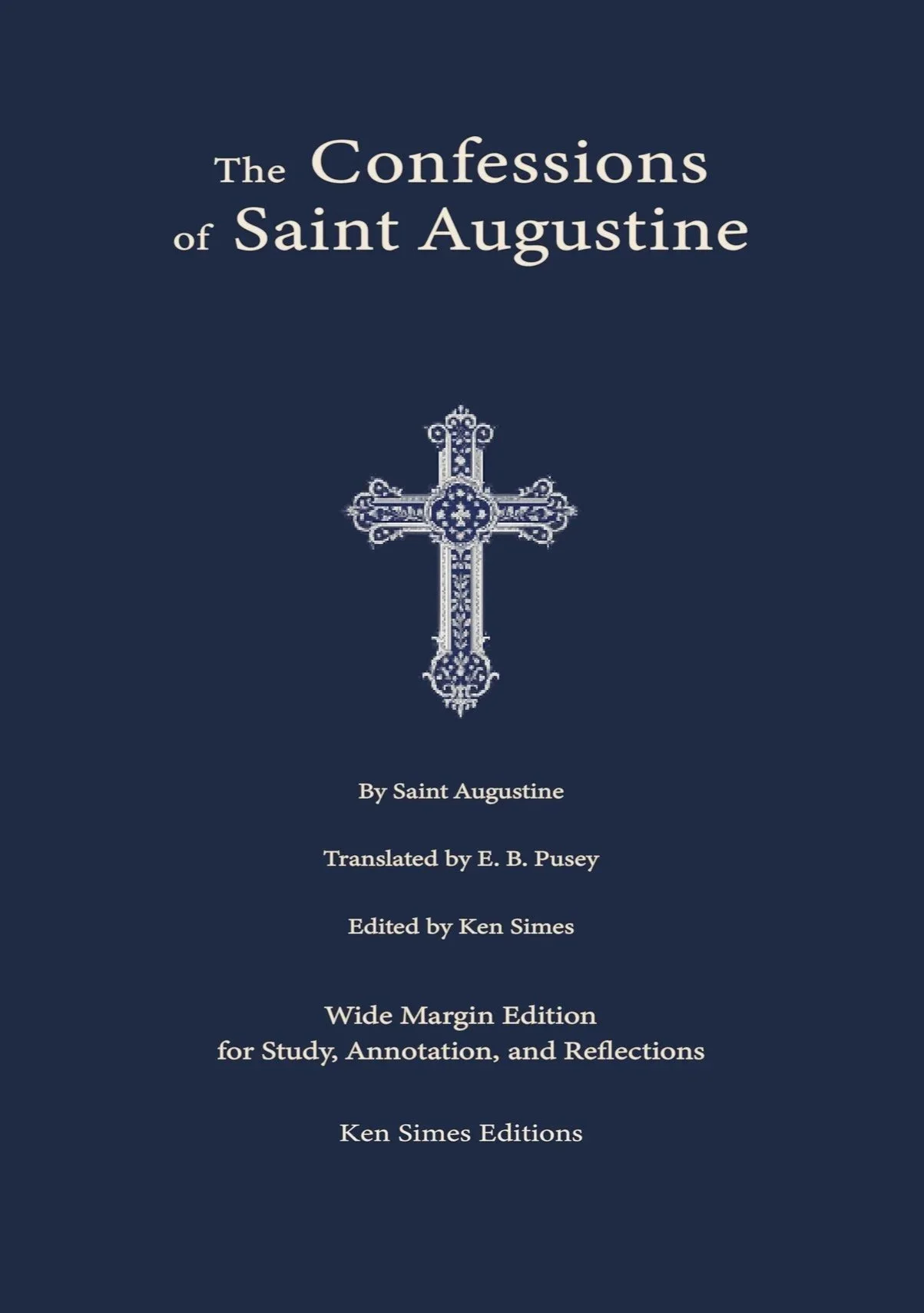
Author:
Saint Augustine
Faith Tradition:
Catholic (with broad Christian readership)
Source Edition:
E. B. Pusey Translation
Available Formats:
Paperback (8.5 × 11), Hardcover (8.25 × 11)
Description:
The Confessions of Saint Augustine stands as one of the most influential works in Christian thought and Western literature. Written as a prayer addressed directly to God, Augustine’s reflections trace his journey through ambition, desire, error, and transformation. The result is a work of striking honesty that explores memory, time, love, and the restless search for meaning that shapes every human life.
A premium wide margin edition designed for study, annotation, and reflection.
This edition is created for readers who want more than a passive reading experience.
It includes:
A custom editorial preface that provides historical and spiritual context
A clean, carefully formatted text for focused reading
Generous wide margins for notes, annotation, and reflection
A dedicated reflections section at the end of the book
Augustine’s writing rewards slow, thoughtful engagement. This edition is intentionally designed to support that process, allowing you to interact with the text, record insights, and return to key passages over time.
Whether used for personal study, group discussion, or spiritual journaling, this format turns Confessions into something more than a book. It becomes a working text.
This volume preserves the public domain text without modernization, allowing readers to encounter Augustine’s language as it has been read for generations. At the same time, the layout and structure are tailored for modern readers who value clarity, durability, and space to think.
Ideal for students, scholars, clergy, and thoughtful readers, this edition transforms a foundational text into a living conversation. It is meant to be read with care, written in, and returned to over time.
Editor’s Preface
Among the earliest works to unite personal narrative with sustained theological reflection, The Confessions of Saint Augustine occupies a singular place in Christian literature. Written near the end of the fourth century, it is neither a memoir in the modern sense nor a systematic exposition of doctrine. Instead, it is a sustained act of self-examination, addressed to God, in which Augustine revisits his own life in order to understand how truth, error, desire, and grace have shaped him.
The result is a work that has remained alive to readers across centuries because it speaks not from a distance, but from within the experience of being human.
Augustine’s world was marked by intellectual ferment and cultural uncertainty. The Roman Empire still stood, yet its foundations were visibly weakening. Classical education remained prestigious, while Christian belief was increasingly influential but far from settled in its theological contours. Augustine himself was formed by this tension. Trained as a rhetorician, he pursued recognition, success, and pleasure with determination. At the same time, he was haunted by questions he could not silence: the nature of truth, the problem of evil, and the conflict between knowing what is right and doing what one desires.
These pressures frame The Confessions, but they never reduce it to a historical artifact. Augustine’s questions are presented as existential problems, not academic exercises.
The work proceeds as a conversation rather than a chronology. Augustine moves fluidly between memory, prayer, Scripture, and philosophical reflection. Childhood, education, friendship, ambition, sexuality, and grief all become subjects of inquiry.
He does not excuse his failures, nor does he dramatize them for effect. Instead, he examines them patiently, asking how disordered love distorts judgment and how habit quietly binds the will. His writing assumes that self-knowledge is inseparable from knowledge of God, and that honest reflection requires humility. The reader is invited into this process, not as a spectator, but as a fellow participant.
This edition is designed to support that kind of engagement. The wide margins provide space to pause, to note questions, and to record responses that arise while reading. Augustine’s thought often unfolds gradually, circling an idea from multiple angles before settling into clarity. Such passages benefit from slow reading and reconsideration.
For example: What does Augustine mean when he speaks of memory as a vast inner storehouse? How does his meditation on time challenge ordinary assumptions about past and future? Where does his struggle illuminate patterns that persist in contemporary life? Writing alongside the text allows these reflections to take shape without being rushed.
Readers should also remain attentive to the historical limits of Augustine’s perspective. His understanding of human nature, sin, and desire reflects the theological debates of late antiquity and his role as a Christian bishop. Some of his conclusions may feel unfamiliar or even uncomfortable to modern readers.
These moments are best approached neither with uncritical acceptance nor with dismissal, but with thoughtful attention. They reveal how seriously Augustine took the task of examining the self before God, even when his answers were provisional or shaped by the constraints of his time.
The enduring significance of The Confessions lies in its exploration of interior life. Augustine insists that the search for meaning is not resolved through achievement, pleasure, or intellectual mastery alone. Instead, it requires an honest reckoning with one’s loves: what they are, how they are ordered, and where they lead. His reflections on desire, habit, and restlessness continue to resonate because they describe patterns that remain deeply familiar.
Long before the language of psychology existed, Augustine articulated the experience of inner division and the longing for wholeness.
This volume presents the public-domain text without modernization, preserving the language through which The Confessions has been read for generations.
At the same time, the layout is intended to make sustained study approachable. Generous margins and a clear structure invite the reader to engage the text actively rather than passively. In this form, the book becomes not only something to be read, but something to be worked through over time.
May this edition of The Confessions of Saint Augustine serve as a companion for thoughtful reading and reflection. Whether approached as a theological work, a philosophical inquiry, or a personal meditation, it invites attention to the movements of the heart and the formation of the will. Above all, it offers a reminder that self-understanding and transformation are not achieved in isolation, but through a patient and honest search for truth.
This edition is part of an ongoing effort to present classic works in formats designed for sustained study and reflection.
—Ken Simes