The Practice of the Presence of God
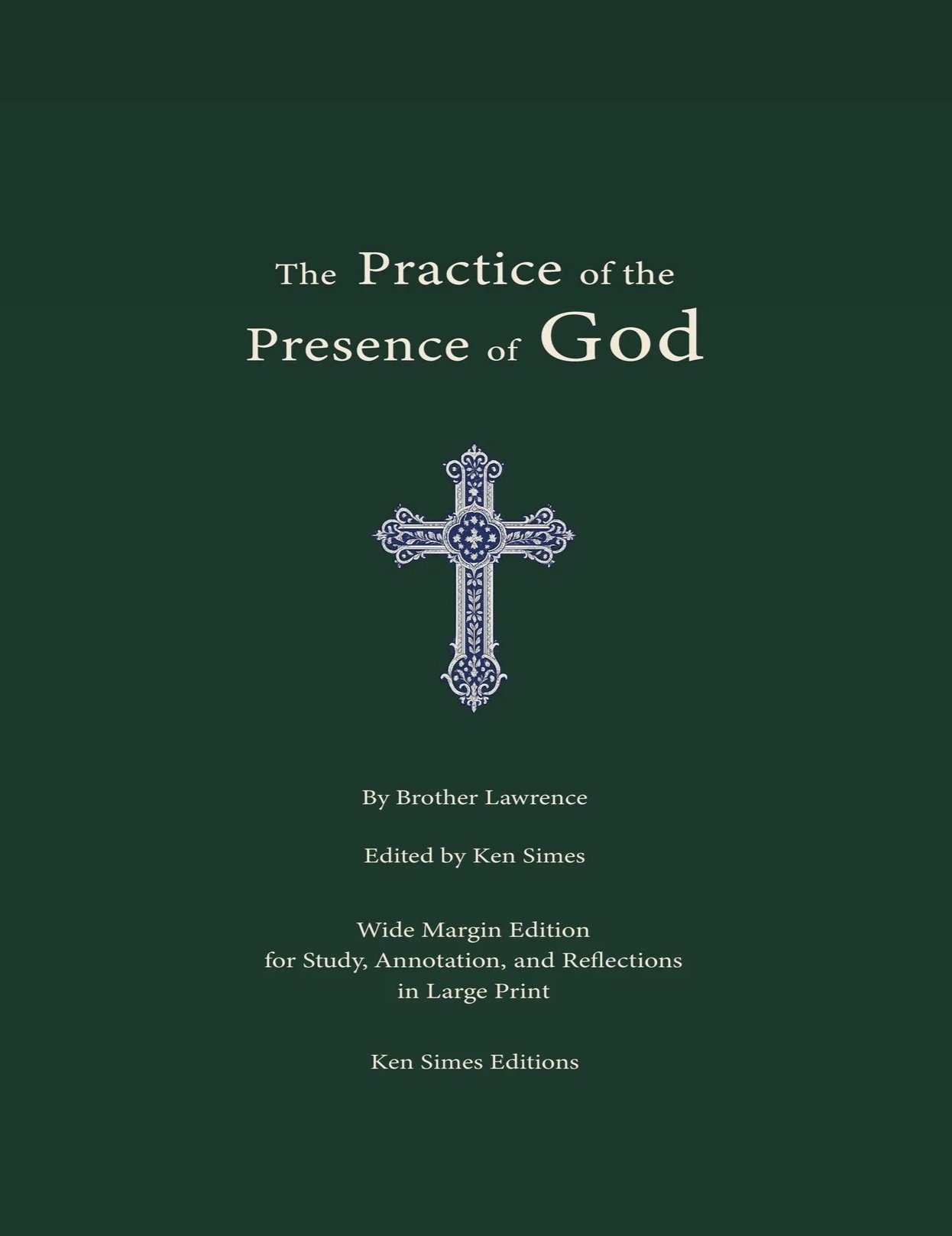
Author:
Brother Lawrence
Faith Tradition:
Catholic (with broad Christian readership)
Source Edition:
1694 Edition; 1914 Translation
Available Formats:
Paperback (8.5 × 11), Hardcover (8.25 × 11)
Description:
The Practice of the Presence of God is one of the most beloved works of Christian devotion ever written.
Drawn from the conversations and letters of Brother Lawrence, a seventeenth century Carmelite lay brother, this brief but powerful work presents a simple and profound vision of the spiritual life. It teaches that communion with God is not reserved for extraordinary moments, but may be cultivated in the ordinary duties and rhythms of daily life.
With clarity and humility, Brother Lawrence describes a way of continual awareness of God’s presence, offering guidance that has encouraged generations of readers seeking a deeper and more constant devotion.
This edition has been carefully prepared for thoughtful reading and study. The text is cleanly typeset and presented in a spacious format, with wide margins designed to support annotation, reflection, and personal engagement.
Ideal for both first time readers and those returning to this classic work, this edition provides a clear and readable presentation of a timeless spiritual guide.
Editor’s Preface
The Practice of the Presence of God, by Brother Lawrence occupies a distinctive place within the history of Christian devotional literature. Rather than presenting a formal theological system or a structured doctrinal treatise, the work consists of conversations, letters, and reflections centered on a single spiritual principle. It emerged from the lived experience of a lay brother in a Carmelite monastery in seventeenth century France, a setting defined by routine, discipline, and simplicity. In this context, the text offers an approach to religious life that emphasizes continual awareness of the divine within the ordinary rhythms of daily activity.
Brother Lawrence was not a trained theologian or a formal teacher. Born Nicolas Herman, he lived much of his life performing practical tasks within the monastery, including work in the kitchen. His writings were not originally intended for publication as a unified work. Instead, they were preserved through the efforts of others who recorded his conversations and collected his letters after his death. This origin shapes the structure of the text. It does not follow a systematic progression of argument, but rather presents a series of insights that return repeatedly to a central idea, that a person can cultivate an ongoing and direct awareness of God regardless of circumstance or setting.
The result is a work that reflects both its historical context and its unconventional form. Written during a period marked by theological debate and institutional authority within the Catholic tradition, it offers a perspective that is notably personal and experiential. Its focus is not on doctrinal precision or ecclesiastical structure, but on inward practice. The emphasis on simplicity, repetition, and intention gives the text a distinctive tone, one that has allowed it to resonate across different Christian traditions and beyond its original setting.
Readers will approach this work from a range of perspectives. For those within religious traditions, it may serve as a guide to devotional practice or spiritual discipline. For others, including former adherents, scholars, and readers interested in the study of religion, it offers insight into how individual belief can be expressed outside formal theological systems. The text rewards careful reading, though its brevity and apparent simplicity can obscure the depth of its underlying claims. Its recurring themes invite reflection rather than passive consumption.
This edition is designed to support thoughtful engagement with the text. Wide margins throughout provide space for annotation, reflection, and personal response. The format encourages readers to pause and consider how the ideas presented relate to broader questions of belief, practice, and meaning. A reflections section at the end of the volume offers additional space to synthesize observations and to engage more deliberately with the themes of the work.
It is important to recognize that The Practice of the Presence of God reflects the spiritual priorities and assumptions of its time. Its language and framework are rooted in the religious context of seventeenth century Catholicism, and some aspects may be unfamiliar or interpreted differently by modern readers. This edition does not attempt to reinterpret or adapt those elements. Instead, it preserves the text in its historical form, allowing readers to encounter it as it has been transmitted and to draw their own conclusions.
Whether read as a devotional guide, a historical document, or an object of critical inquiry, The Practice of the Presence of God remains a significant contribution to the literature of spiritual reflection. It invites readers to consider how attention, intention, and habit shape inner life, and how enduring ideas can emerge from the most ordinary circumstances.
—Ken Simes