The Scarlet Letter
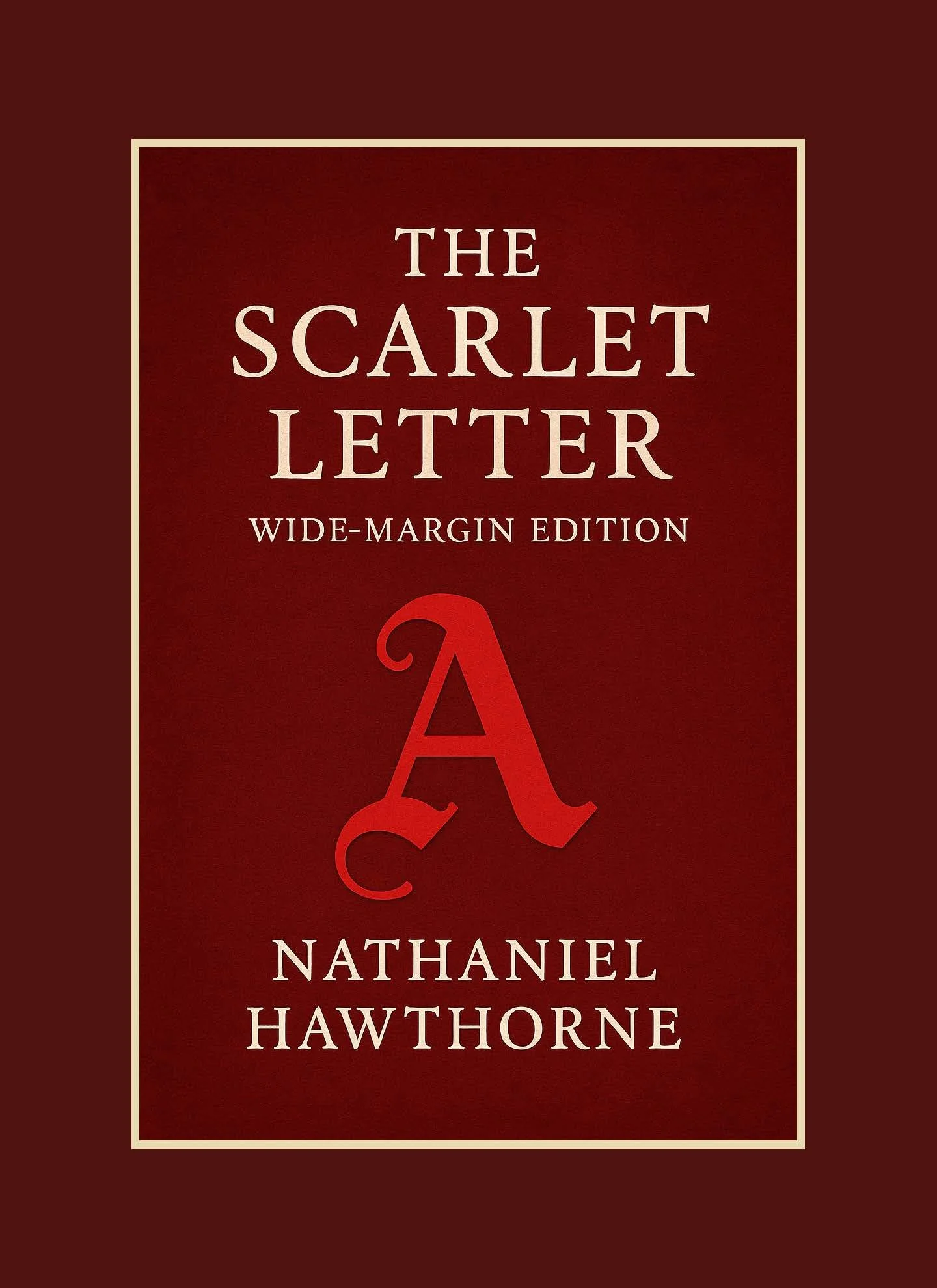
Author:
Nathaniel Hawthorne
Source Edition:
1850 Edition
Available Formats:
Paperback (8.5 × 11)
Description:
Nathaniel Hawthorne’s The Scarlet Letter remains one of the most enduring works of American literature, a novel that explores sin, guilt, and redemption in seventeenth century Puritan New England. This edition has been carefully designed to serve both readers who wish to experience the novel in its original spirit and those who want to engage in deeper study.
Features of this Edition
Wide note-taking margins on letter size pages provide generous space for notes, cross-references, and annotations.
A new preface by the editor introduces the work with a personal perspective, reflecting on the lessons of tolerance, justice, and critical thought that this classic continues to inspire.
A concluding section titled Reflections provides dedicated pages for readers to record their insights, questions, and responses as they progress through the novel.
Clean and elegant typesetting preserves immersion while supporting an interactive reading and study experience.
Why This Edition
This is more than a reproduction of Hawthorne’s novel. It is a tool for learning. Readers are encouraged to write in the margins, circle key passages, and use the book as a working companion for study, teaching, or personal reflection. Every detail of the formatting balances readability with functionality, creating an edition that feels both authentic and practical.
Whether you are encountering The Scarlet Letter for the first time or returning to it with new perspective, this wide margin study edition invites you not only to read but also to respond. It is a book to learn from, to live with, and to make your own.
Editor’s Preface
I first encountered The Scarlet Letter as a high school student. Until then, much of what I had read in school assignments had been straightforward, imparting lessons while evoking innocent hope and adventure. Hawthorne’s novel struck me differently. It was my first real introduction to literature that not only told a story but also held up a mirror in challenge to the society that produced it. The story of Hester Prynne, her punishment, and the relentless public scrutiny she endured revealed how social norms can be used to control and exclude just as easily as they can guide.
Reading it at that age challenged me to think about my own society in ways I had not before. I began to recognize that customs, traditions, and expectations are not immutable truths, but choices that people reinforce or resist. Hawthorne’s Puritan Boston felt far away in time, but the themes of shame, intolerance, and public judgment were strikingly familiar. I began to evaluate my own values, realizing there was more to explore within me. That realization planted the seed of a question I still carry with me: how can we work toward building communities that favor tolerance and justice, rather than perpetuate cycles of stigma and exclusion?
This edition is designed with the reader’s engagement in mind. The wide margins invite you to treat the book as more than a text to be read passively. Use them fully. Go ahead and jot notes, mark important phrases, circle or underline passages that resonate with you. Place tabs on the pages you want to return to. At the back, a section of blank pages labeled Reflections provides additional space for longer thoughts, commentary, or personal responses. In using these features, the book becomes both Hawthorne’s work and your own record of reading it, a dialogue across time. It’s thrilling to me to look back at my own notes and see new ideas and themes take form.
In preparing this edition, I strove to preserve the immersive feel from reading a compelling novel. I relish that experience. I balanced that feeling against practical features that support study and note-taking. The text remains intact as Hawthorne published it, beginning with The Custom-House and continuing through all twenty-four chapters, but the format allows the reader to participate in a way that standard printings often do not. My hope is that this edition serves not only as a faithful reproduction of a classic but also as a working tool for learning and self-reflection.
—Ken Simes